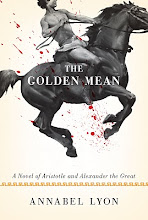
Sunday, August 30, 2009

Westender Interview

"This bond between taciturn master and bold student is the basis of the first novel by Vancouver writer Annabel Lyon. Set in the 4th-century Macedonian capital city of Pella, and told from the great philosopher’s point of view, The Golden Mean brings Aristotle to life, free of the scholarly reverence that is so often foisted upon him."

To read Steven Schelling's full article for the Westender, please click here.

Saturday, August 29, 2009

Unmentionables

Here are some of the words I realized I couldn't use while writing The Golden Mean:

velvety I used this to describe a baby's scalp before discovering that velvet was a Medieval fabric, unknown to the ancients.

rubbery To describe a person's face. Oops.

stirrups Invented by the Romans. The Greeks had saddles; the Macedonians, great horsemen, liked to ride bareback.

Caeserian This operation actually was performed by the ancient Greeks (with one shudders to guess what success), but the term was obviously of Roman origin. I had to get the incision in the right direction, too; initially I had Aristotle's father make the cut along the bikini line, as surgeons would today; but until quite recently, surgeons cut from the navel downwards, leaving a vertical rather than a horizontal scar.

And some of the words I got away with:

silk The famous silk roads, the great trading routes between Europe and Asia, were opened up by Alexander, so silk would have been all but unknown before his great campaigns. I had to change all Pythias's dresses from silk to historically accurate linen. I did allow myself to keep one metaphorical use ("the truth slipped like silk") because I just couldn't come up with a word I liked better.

tar The ancients had pine tar, particularly useful for sealing ships.

beer The Macedonians brewed barley beer, something like Medieval mead. Because the weather in mountainous Macedonia tended to be cool and rainy in the winters, grapes didn't thrive as well as in the warmer, sunnier south, and wine had to be imported.

fuck The Greeks looked on the Macedonians as vulgar barbarians, wealthy but crude, who had to import what culture they possessed. Looking for a way to distinguish in English between Greek and the Macedonian dialect, I struck on an analogous use of British and North American English. My Athenians would speak like Brits, my Macedonians like North Americans. "Do they have to curse like rappers?" an acquaintance (born in England) asked me plaintively after reading a draft. Exactly!

The 26-volume Oxford English Dictionary was an invaluable resource when anachronism became a worry. It not only provides definitions, but cites the first known use of your word, a huge bonus for the historical novelist. If anyone's wondering what to get me for Christmas....

Sunday, August 23, 2009

Winnipeg Free Press Review

"This historical novel adds a refreshingly human dimension to ancient Greek civilization and the world-changing ideas that it produced."

To read Ezra Glinter's full review for the Winnipeg Free Press, click here.

Thursday, August 20, 2009

Georgia Straight Profile

"...a book which, remarkably, reminds us that ethical behaviour is at the heart of what it means to be human, while making us feel as close to its near-legendary subjects as we do to our own friends and neighbours."

To read Alexander Varty's profile in the Georgia Straight, please click here:

With The Golden Mean, Annabel Lyon revives ancient ethics | Vancouver, Canada | Straight.com

Tuesday, August 18, 2009

Monday, August 17, 2009

Aquamanile: Phyllis Riding Aristotle

This aquamanile (a vessel used for ritual hand-washing) is in the Metropolitan Museum of Art in New York. Dating from the southern Netherlands or eastern France, circa 1400, it depicts Aristotle allowing himself to be humiliated by Phyllis, supposedly a favourite courtesan of his student, Alexander. According to a popular morality tale from the later Middle Ages, Aristotle was teaching Alexander a lesson about the dangers of feminine wiles. I love the exquisite weirdness of this piece, and its irony. I would call it "The Misogynist Gets His Due".

Phyllis_aquamanile

Aristotle ridden by Phyllis

Saturday, August 15, 2009

Vancouver Sun Review

"...a taut, polished novel that will hold your attention from start to finish. It is at times funny, thought-provoking, sensual and suspenseful."

To read Joe Wiebe's lovely profile and review for the Vancouver Sun, please click here: The philosopher and the warrior

Friday, August 14, 2009

Reviews

The Golden Mean is a crisply written, painstakingly researched book, and Lyon ably inhabits ‘the greatest mind of all time’...”

Read Cynthia MacDonald's full review of The Golden Mean for the Globe and Mail here.

“...an audacious attempt to create a flesh and blood Aristotle, with intimate glances into his psyche...”

Read Philip Marchand's full review for the National Post here.

“Lyon must be applauded for a daring and challenging approach to fiction.”

Read Candace Fertile's full review for the Edmonton Journal here.

Thursday, August 13, 2009

Oh, Those Romans (Film and TV)

One of the biggest challenges of setting a novel in the ancient world was writing dialogue that didn't sound silly or stilted. ("Silence, by Zeus!", thundered the king.) I wanted the characters to sound like real people, not extras from Troilus and Cressida, let alone cartoons. Curious about how others had tackled this problem, I turned to movies.

One problem that came up again and again was diction: for some reason, all my characters kept trying to talk like they were British. I realized this went back to Robert Graves . I first watched the great 1976 BBC adaptation of his novels I, Claudius and Claudius the God when I was a child. Despite the English accents, the dialogue is fresh and spiky without sounding anachronistic (see clip below).

I had hopes that the recent HBO series Rome would have an even more contemporary feel. Indeed, despite (again!) the English accents, the characters felt immediate and recognizable, people you could talk to rather than just listen to.

Finally, for a bit of cinematic ancient Greece, find Pier Paolo Pasolini's astonishing 1967 movie Oedipus Rex. Pasolini has claimed that the film was autobiographical. An intense, beautiful, strange journey through a landscape that's both dream-like and utterly credible.

Here's a clip of one of my favourite I, Claudius characters, the empress Livia, instructing her gladiators:

Wednesday, August 12, 2009

Martha the Great


I first read Martha Nussbaum as an undergraduate philosophy student at Simon Fraser University in Burnaby, BC. The Fragility of Goodness: Luck and Ethics in Greek Tragedy and Philosophy examines the ethical thought of Plato and Aristotle, but also Aeschylus, Sophocles, and Euripides, as manifested in their tragic dramas. When I read this book, a lot of vague and unsettled ideas I'd been struggling toward fell into place with one of those profoundly satisfying clicks you hope to experience once or twice in your intellectual life. I realized my interests in fiction and philosophy were not mutually exclusive. Not only could they co-exist, they might in fact be different facets of the same interest, two itches that could be scratched with the same finger.

Love's Knowledge: Essays on Philosophy and Literature continues her project of mining literary works for ethical and philosophical insights. It includes essays on Aristotle, Plato, Henry James, Charles Dickens, and Samuel Beckett. She's also written books on education, religion, economics, and law.

Martha Nussbaum is the Ernst Freund Distinguished Service Professor of Law and Ethics at the University of Chicago.

Sunday, August 9, 2009

Today's the Day!

The wait is over: The Golden Mean hits the shelves today. Thanks to all who've been following this blog and have decided to give the book a try. Keep visiting this site for news of my readings, festival appearances, etc. I'd love to sign your copy and hear what you think of it. Stay tuned, too, for more clips, pictures, and tasty tidbits about life in ancient Macedonia. Opa!

Saturday, August 8, 2009

The Ancient City of Pella

Pella, the capital of ancient Macedon, was in Aristotle's time at the mouth of a delta. The delta has silted up over the past couple of thousand years; the archaeological site you can visit today is well inland. Aristotle lived in and around Pella for the seven years he spent tutoring the young Alexander the Great. There's speculation, too, that he might have spent time there as a child or teen, after his father was appointed personal physician to the king at that time, Amyntas.

Pella was a wealthy, modern city for its time. In addition to being a political centre, Pella was a significant commercial hub and featured an enormous marketplace surrounded by arcades and workshops. Here's a look at the archeological remains:

Wednesday, August 5, 2009

And Now for Something Completely Different

One of my earlier posts, "Ten Uses for a Philosophy Degree", omits the best use of all: become a comedian. Woody Allen and Steve Martin both studied philosophy, and someone in the Monty Python troupe must have taken a class or two at Cambridge....

Monday, August 3, 2009

Creating Character: Philip

phil of macedon's helmet

This, to me, is elegant menswear. Philip's helmet was buried with him in his tomb, in Vergina, and can be seen today in the museum there. Philip inherited a kingdom in perilous disarray; by the end of his life, Macedon ruled all of Greece, and Philip's troops were preparing to invade Persia. Were he not subsequently overshadowed by his more famous son, Philip would be remembered today as one of the most brilliant rulers of the ancient world. He was a fun character to create, a likeable rogue: a fierce soldier, canny politician, drinker, womanizer, and surprisingly pragmatic diplomat.

His conflict with Alexander sprang, I think, from the fundamental difference in their characters: Philip wanted to conquer the known world, but Alexander wanted to conquer the unknown world. For all their similarities, he lacked his son's compulsive curiousity. The Oedipal conflict is also vivid in Philip and Alexander's relationship. Freud read Shakespeare; Shakespeare read Plutarch; and Plutarch, one of Alexander's earliest biographers, would have known his Sophocles.

Philip was stabbed to death at his daughter's wedding by one of his bodyguard, a man named Pausanias. Historians have speculated the assassin was hired by Alexander, impatient to assume the throne; or his mother, Olympias, jealous of Philip's recent marriage to a much younger wife; or both of them together. Conveniently, Pausanias is supposed to have tripped as he ran across a vineyard toward his getaway horse, and was caught and torn to pieces before he could be questioned.

Thursday, July 30, 2009

Historical Fiction Faves

Historical fiction has lately devolved into genre fiction, featuring predictable stories (usually of forbidden love) and affording readers the opportunity for moral outrage at a safe historical distance. It's fun and easy--but not especially challenging or intellectually engaging--to feel yourself on the right side of issues like misogyny, racism, classism, gay rights, etc.

As James Wood wrote in a recent New Yorker review, "Sometimes, the soft literary citizens of liberal democracy long for prohibition. Coming up with anything to write about can be difficult when you are allowed to write about anything. A day in which the most arduous choice has been between "grande" and "tall" does not conduce to literary strenuousness."

The historical fiction I enjoy tends to subvert or ignore the tropes of the genre. Here are three novels about the ancient world that subvert, surprise, challenge, and please.

David Malouf's An Imaginary Life (1978). The Roman poet Ovid is exiled to a barbarian village at the edge of the Black Sea, where he ends up caring for a feral child. Most historical fiction tries to impress the reader with the sophistication of the period it recreates (for some reason my mind jumps here to Gwyneth Paltrow's toothbrush thingy in Shakespeare in Love). Malouf, in contrast, portrays the absolute fear and dread of the 'civilized' mind (represented by Ovid) in the face of the truly primitive. The author powerfully conveys the sheer otherness of the ancient world.

Grant Buday's Fireflies (2008). A prose retelling of the Iliad from Odysseus' point of view. The great strength of Buday's novel isn't in any formal innovation or revisionism. Rather, it's the crispness and humour and beauty of the prose that make this book worth seeking out.

Mary Renault's Fire From Heaven (1969). The first twenty years of Alexander the Great's life, including his time with Aristotle, from the boy's own point of view. This novel is the first of a trilogy about the life of Alexander. I avoided reading this one for a long time because it dealt with many of the events I was writing about, and I didn't want to have my conception of events influenced by another fiction writer. When I finally finished my own novel and allowed myself to read Renault, I was relieved I hadn't read her sooner, because I would have been completely psyched out: the writing is excellent, the research immaculate, the characters psychologically profound. I particularly appreciated her no-nonsense portrayal of Alexander's bisexuality. A lesser author would have made this the focus of the novel, but Renault is cool enough not to let the hot stuff derail her larger narrative.

If you're wondering when I'm going to get around to Robert Graves, the answer is in a future post about TV and film, since I was introduced to his work through the great 1976 BBC adaptation of his novels I, Claudius and Claudius the God. Stay tuned!

Wednesday, July 29, 2009

12 or 20 Questions

Please click here to see my "12 or 20 Questions" interview with Rob McLennan.

Tuesday, April 21, 2009

Melismos

This performance is by the Australian group Melismos (Michael Atherton, Philip South & Mina Kaniridis), which specializes in recreating ancient Greek music. Atherton plays the 7-string lyre (kithara). For more, visit Atherton's MySpace page.

The music is an Invocation to the Muse. Translation: 'Sing for me, dear Muse, begin my tuneful strain; a breeze blow from your groves to stir my listless brain' and 'Skillful Calliope, leader of the delightful Muses, and you, skillful priest of our rites, son of Leto, Healer-god (paean) of Delos, be at my side' (J. G. Landels).

Hang on for a haunting ending on the frame drum.

Tuesday, April 14, 2009

Creating Character: Alexander


Alexander The Great
Originally uploaded by Philippe C.

I knew I wanted the kid to be annoying. There's a reverent literary tradition around Alexander, beginning with his first biographers (Arrian, Plutarch), through the so-called Alexander Romances of Medieval times (where he often had superpowers), right up to the present (most recently with Oliver Stone's 2004 biopic Alexander, featuring Irish heartthrob Colin Farrell).

But years as a teacher have taught me that teenagers with brains and talent are often the most arrogant, insecure, and impossible students of all. I wanted to create a character who would both defy expectations and be immediately recognizable to anyone who's ever had to deal with an exceptionally bright, difficult teenager. I pictured the young Alexander as an annoying narcissist who needed to be taken down a few notches. Just the job for my fictional Aristotle, whose brilliance I much preferred (in the beginning, anyway) to Alexander's brawn.

But I struggled. Early readers told me they believed Alexander as an annoying teenager but couldn't see the seeds of the man who would conquer the world. The more I thought about him, the more he bothered me. I knew he needed to be more than just a smart-aleck, but I still couldn't buy into the tradition of the sexy, hotheaded military genius.

The penny finally dropped when I read an article in the September 29, 2008 New Yorker about an Iraq war veteran suffering from post-traumatic stress disorder (William Finnegan's "The Last Tour"). I was struck by the symptoms Finnegan described--headaches, nightmares, alcoholism, loss of touch with reality, and most of all the paradoxical desire to be at home when you're at war and at war when you're home. These symptoms fit the later Alexander (an alcoholic given to fits of blinding violence immediately followed by crippling depressions, who left home at 19 and never returned).

The more I thought about the boyhood that must have preceded this tormented life, the more I wondered if the trauma might have begun very early indeed. His parents by all accounts hated each other. His father took numerous wives and produced half-siblings often enough to keep the young prince's expectations about his future off-balance. His mother was suspected of witchcraft. Alexander was trained as a child soldier, leading troops into battle when he was only 16.

Child soldiers exist today, and we know what damage and trauma they suffer (when we allow ourselves to think about them at all). An ancient child would have suffered no less. Once I understood that, I understood how to proceed with the character I now cared and feared for as much as anyone in the novel.

Saturday, April 11, 2009

Aristotle's birthplace

Today we associate Aristotle with the golden age of Athenian philosophy, in one of the great cultural successions (Socrates taught Plato taught Aristotle, like Haydn taught Mozart taught Beethoven). But Aristotle was actually born in Thrace, in the little village of Stageira, on a hillside overlooking the sea. Thrace was defeated by Macedon in Aristotle's lifetime and Stageira was razed at the end of his time at Plato's Academy. The village was rebuilt years later, supposedly as a gift from Philip to Aristotle for the years he spent tutoring Philip's son, Alexander.

The Athenians never considered Aristotle one of their own. Though he spent the last twelve years of his life living and teaching in Athens, he was forced to leave the city after Alexander's death, when Athenian sentiment turned against anyone associated with Macedon. Aristotle is supposed to have said he didn't want "the Athenians to sin twice against philosophy", a reference to Socrates' execution.

Here's a 30-second clip of the ruins of Stageira:

Tuesday, April 7, 2009

And Now, Some Recipes

Had you attended the funerary feast of the ancient Phrygian King Midas, around 800BCE in what is now central Turkey, you would have eaten lamb and lentil stew. The archaeological site was first discovered in the 1950's, but it wasn't until 1998 that a chemical archaeologist at the University of Pennsylvania Museum, Dr. Patrick McGovern, had the technology to analyze cook-pot residues.

He found a drink made of a mixture of grape wine, barley beer and honey mead. (In both the Iliad and the Odyssey, Homer describes a drink made from wine, barley meal, honey, and goat cheese). Small jars contained fatty acids and lipids associated with sheep or goat fat; phenanthrene and cresol, suggesting the meat was barbecued before it was cut from the bone; gluconic, tartaric, and oleic/elaidic acids implying the presence of honey, wine and olive oil respectively (perhaps a marinade?); and a high-protein pulse, likely lentils. Traces of herbs and spices completed the dish.

Despite its far-reaching spider web of trade routes (particularly in the wake of Alexander's great Eastern campaigns), the ancient world was made up largely of locavores. (We moderns think we're so trendy!) A typical Macedonian diet in Aristotle's time would have featured a lot of bread and fish, and seasonal fruits and vegetables. (Both Alexander and his father, Philip, were supposed to have had a passion for apples).

Meat was a luxury unless you were extremely wealthy. Goat and mutton were most common; chicken, duck, goose, and rabbit were also available; beef was rarely eaten. Staple proteins were beans, eggs, cheese, yoghurt, and nuts. Wine was brewed far stronger than we know it today and was usually served with water, as we'd serve scotch. Barley beer was popular in Macedon, less so in warmer, sunnier southern Greece, where grapes were more plentiful.

Alisa Smith and J.B. MacKinnon's Vancouver-centric The 100-Mile Diet: A Year of Local Eating was surprisingly helpful when I tried to picture an ancient kitchen. It made me think about all the foods I took for granted that Aristotle would never have heard of (black tea, coffee, mangoes, sugar, pepper, salmon, chocolate, etc.). It also made me think hard about food storage and seasonal availability; at one point I caught myself giving my characters a meal of roast lamb in autumn--whoops. In the final draft, they get goat.

Historical novelists like to describe food. It's a double urge, I think: to surprise the reader with the sophistication of the era they're describing, and to make the period instantly accessible. How hard is it to imagine sitting down to a plate of feta and walnuts, or a nice, spicy lamb-lentil stew and a beer?

A couple of websites featuring approximations of ancient Greek recipes are ancientgreekfood.net and greek-recipe.com.

Saturday, April 4, 2009

Ten Uses for a Philosophy Degree

1. Torment your parents. You're majoring in what?

2. Go to graduate school. You're never going to get a real job.

3. Go to law school. Oh, thank god, thank god, she's come to her senses. She says those logic courses helped her with the LSAT and having studied ethics might be a real advantage. No, of course I didn't tell her that. You want to put her off before she's even started?

4. Become a nihilist. You dropped out of law school? After one year? What do you mean, you're depressed? We're all depressed! But they'll take you back, right, when you come to your senses? And put that black t-shirt in the laundry, my god, don't you own any other clothes? Don't you want a pension and dental? What is the matter with you?

5. Laugh extra hard at that Monty Python sketch about the all-Bruce philosophy department at the University of Walamaloo (Australia, Australia, Australia, we love you!).

6. Fan yourself with it while imagining you're Lasthenea of Mantinea or Axiothea of Phlius, the only women known to have attended Plato's Academy.

7. Get an MFA in Creative Writing. So, graduate school after all. Which is more useless, do you think, philosophy or creative writing? Hmmm?

8. Read your old textbooks when you feel stressed. Seriously, you do that? Aristotle's Nicomachean Ethics? Seriously?

9. Get a job in spite of it. Teaching writing? Do you get a pension and dental with that?

10. Write a novel about Aristotle. I began The Golden Mean in late-September 2001. Like many other privileged North Americans in the arts, I was questioning the relevance of my work in the aftermath of the attacks in New York and Washington. I struggled to read and write fiction, but found some solace in Aristotle. The things he thought about 2300 years ago--what makes a good government? what's a tragedy? what does it mean to lead a good life?--were the things everyone was suddenly thinking and talking about. For me, his words were serious, intelligent, contemporary, alive.

One day I read the thumbnail bio in the front of my copy of his Ethics and found myself wondering--just wondering, really. What would he have made of contemporary political polarities? What did he eat for breakfast? Did he like teaching? Why the particular interest in marine biology? How did he meet his wife?

Finally, I realized the only way I would ever find my way back to the abiding worth of fiction was through this most challenging, engaging, and relevant of subjects.

Friday, April 3, 2009

Aristotle's Thought, Sort Of

Concise and very funny - enjoy.
(This is the first of three clips from the same lecture, all available on Youtube.)