Friday, February 18, 2011
PEN Anthology
To read "Alexander", my contribution to the brand-new PEN anthology Finding the Words (edited by Jared Bland), please click here.
Wednesday, September 8, 2010
The Kalash
Kalash customs differ drastically from those of the Muslim population surrounding them: men and women mix freely, women don't cover their faces, marriage by elopement is common, and women can change husbands if the new husband is willing to pay twice the dowry of the old one. Girls and women are sequestered during menstruation and childbirth, however, until they regain their "purity".
According to Wikipedia, the Kalash population stands at about 6000 and UNESCO considers the Kalasha language critically endangered.
Friday, February 12, 2010
bookbuffet.com

•PART I: I give a synopsis of Aristotle's life and read from The Golden Mean
•PART II: I discuss my hypotheses that Aristotle was bipolar and Alexander suffered from post traumatic stress syndrome
•PART III: I talk about my upcoming book-the sequel to The Golden Mean
Wednesday, January 13, 2010
A Tetradrachm for your Thoughts
According to Wikipedia, "Lysippus' sculpture, which is opposite to his often vigorous portrayal, especially in coinage of the time, is thought to be the most faithful depiction of Alexander."
Courtesy of the trustees of the British Museum; photograph, J.R. Freeman & Co. Ltd.
Sunday, January 3, 2010
Word of the Day
Tuesday, November 17, 2009
Word of the Day


The sarissa was invented by Philip of Macedon, Alexander's father. It was a pike, considerably longer than its predecessor, used in phalanx formations. The advantages were comparable to a boxer with an extra-long reach; the disadvantages included its considerable weight. A soldier needed both hands for the sarissa, entailing only a small shield hung from the neck.
Sarissa is also a girl's name, supposedly a derivative of Sarah, meaning "princess" or "lady" (see photos.)
Sunday, October 4, 2009
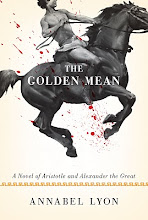
The Boy on the Cover
Alexander had an older half-brother named Arrhidaeus. The Roman historian Plutarch, who wrote a canonical early biography of Alexander, claims Arrhidaeus became an "idiot" following a childhood illness, or perhaps poisoning. In my novel, he's suffered brain damage as a result of meningitis (though the ancient Greeks, of course, had neither of those terms).
His affliction didn't seem to make him any less of a threat to Alexander, who freaked out (another term the Greeks probably didn't have) when their father arranged a politically convenient marriage for Arrhidaeus to the daughter of the satrap of Caria. Thinking Philip was positioning Arrhidaeus for the throne, Alexander sent an intermediary to the satrap, offering himself in his brother's stead. When Philip found out, he had the intermediary (a popular tragic actor named Thettalus) paraded through the streets in chains, and banished most of Alexander's closest friends. The offer of marriage, obviously, was withdrawn.
Arrhidaeus did eventually become king, after Alexander's death, and ruled with what we can only assume was enormous assistance from the general Antipater.
In the novel, I imagine Aristotle tutoring both princes: Alexander out of duty, Arrhidaeus out of scientific curiousity. In an early scene, the philosopher discovers Arrhidaeus loves horses and decides to teach him to ride. Once mounted, Aristotle wants the boy to sit up straight.
"'No, no,' a groom who's been watching them says. 'Now you hug him,' and leans forward with his arms around an imaginary mount. Arrhidaeus collapses eagerly onto the horse's back and hugs him hard."
Monday, September 28, 2009
Word of the Day
The name "Kandahar" is a corruption of "Alexander" ("Iskander" in ancient Persian). Alexander the Great founded the Afghan city in 330BCE.
I found this photo on flickr.com. It was taken just outside Kandahar, Saskatchewan.
Monday, August 3, 2009
Creating Character: Philip
This, to me, is elegant menswear. Philip's helmet was buried with him in his tomb, in Vergina, and can be seen today in the museum there. Philip inherited a kingdom in perilous disarray; by the end of his life, Macedon ruled all of Greece, and Philip's troops were preparing to invade Persia. Were he not subsequently overshadowed by his more famous son, Philip would be remembered today as one of the most brilliant rulers of the ancient world. He was a fun character to create, a likeable rogue: a fierce soldier, canny politician, drinker, womanizer, and surprisingly pragmatic diplomat.
His conflict with Alexander sprang, I think, from the fundamental difference in their characters: Philip wanted to conquer the known world, but Alexander wanted to conquer the unknown world. For all their similarities, he lacked his son's compulsive curiousity. The Oedipal conflict is also vivid in Philip and Alexander's relationship. Freud read Shakespeare; Shakespeare read Plutarch; and Plutarch, one of Alexander's earliest biographers, would have known his Sophocles.
Philip was stabbed to death at his daughter's wedding by one of his bodyguard, a man named Pausanias. Historians have speculated the assassin was hired by Alexander, impatient to assume the throne; or his mother, Olympias, jealous of Philip's recent marriage to a much younger wife; or both of them together. Conveniently, Pausanias is supposed to have tripped as he ran across a vineyard toward his getaway horse, and was caught and torn to pieces before he could be questioned.
Monday, July 27, 2009
Tuesday, April 14, 2009
Creating Character: Alexander
Alexander The Great
Originally uploaded by Philippe C.
I knew I wanted the kid to be annoying. There's a reverent literary tradition around Alexander, beginning with his first biographers (Arrian, Plutarch), through the so-called Alexander Romances of Medieval times (where he often had superpowers), right up to the present (most recently with Oliver Stone's 2004 biopic Alexander, featuring Irish heartthrob Colin Farrell).
But years as a teacher have taught me that teenagers with brains and talent are often the most arrogant, insecure, and impossible students of all. I wanted to create a character who would both defy expectations and be immediately recognizable to anyone who's ever had to deal with an exceptionally bright, difficult teenager. I pictured the young Alexander as an annoying narcissist who needed to be taken down a few notches. Just the job for my fictional Aristotle, whose brilliance I much preferred (in the beginning, anyway) to Alexander's brawn.
But I struggled. Early readers told me they believed Alexander as an annoying teenager but couldn't see the seeds of the man who would conquer the world. The more I thought about him, the more he bothered me. I knew he needed to be more than just a smart-aleck, but I still couldn't buy into the tradition of the sexy, hotheaded military genius.
The penny finally dropped when I read an article in the September 29, 2008 New Yorker about an Iraq war veteran suffering from post-traumatic stress disorder (William Finnegan's "The Last Tour"). I was struck by the symptoms Finnegan described--headaches, nightmares, alcoholism, loss of touch with reality, and most of all the paradoxical desire to be at home when you're at war and at war when you're home. These symptoms fit the later Alexander (an alcoholic given to fits of blinding violence immediately followed by crippling depressions, who left home at 19 and never returned).
The more I thought about the boyhood that must have preceded this tormented life, the more I wondered if the trauma might have begun very early indeed. His parents by all accounts hated each other. His father took numerous wives and produced half-siblings often enough to keep the young prince's expectations about his future off-balance. His mother was suspected of witchcraft. Alexander was trained as a child soldier, leading troops into battle when he was only 16.
Child soldiers exist today, and we know what damage and trauma they suffer (when we allow ourselves to think about them at all). An ancient child would have suffered no less. Once I understood that, I understood how to proceed with the character I now cared and feared for as much as anyone in the novel.