1. Torment your parents. You're majoring in what?
2. Go to graduate school. You're never going to get a real job.
3. Go to law school. Oh, thank god, thank god, she's come to her senses. She says those logic courses helped her with the LSAT and having studied ethics might be a real advantage. No, of course I didn't tell her that. You want to put her off before she's even started?
4. Become a nihilist. You dropped out of law school? After one year? What do you mean, you're depressed? We're all depressed! But they'll take you back, right, when you come to your senses? And put that black t-shirt in the laundry, my god, don't you own any other clothes? Don't you want a pension and dental? What is the matter with you?
5. Laugh extra hard at that Monty Python sketch about the all-Bruce philosophy department at the University of Walamaloo (Australia, Australia, Australia, we love you!).
6. Fan yourself with it while imagining you're Lasthenea of Mantinea or Axiothea of Phlius, the only women known to have attended Plato's Academy.
7. Get an MFA in Creative Writing. So, graduate school after all. Which is more useless, do you think, philosophy or creative writing? Hmmm?
8. Read your old textbooks when you feel stressed. Seriously, you do that? Aristotle's Nicomachean Ethics? Seriously?
9. Get a job in spite of it. Teaching writing? Do you get a pension and dental with that?
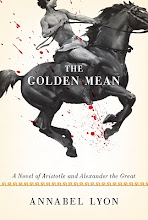
10. Write a novel about Aristotle. I began The Golden Mean in late-September 2001. Like many other privileged North Americans in the arts, I was questioning the relevance of my work in the aftermath of the attacks in New York and Washington. I struggled to read and write fiction, but found some solace in Aristotle. The things he thought about 2300 years ago--what makes a good government? what's a tragedy? what does it mean to lead a good life?--were the things everyone was suddenly thinking and talking about. For me, his words were serious, intelligent, contemporary, alive.
One day I read the thumbnail bio in the front of my copy of his Ethics and found myself wondering--just wondering, really. What would he have made of contemporary political polarities? What did he eat for breakfast? Did he like teaching? Why the particular interest in marine biology? How did he meet his wife?
Finally, I realized the only way I would ever find my way back to the abiding worth of fiction was through this most challenging, engaging, and relevant of subjects.
Showing posts with label literature. Show all posts
Showing posts with label literature. Show all posts
Saturday, April 4, 2009

Thursday, April 2, 2009
All the Life You Can Fit on a Postage Stamp

Vienna, Museum of Art History, Collection of Classical Antiquities. Head of Aristotle.
Originally uploaded by sssn09
From the ocean of historical knowledge, what's known for sure about Aristotle's life would fill a thimble. Good news for this fiction writer (though some historical novelists seem to thrive on a wealth of detail - I'm thinking of Colm Toibin's The Master, inspired in no small part by Leon Edel's five-volume life of Henry James).
The bare bones are these: Aristotle was born in 384BCE in Stageira, Thrace. His father, Nicomachus, was physician to the king of Macedonia, and one can assume both from Greek custom and from Aristotle's subsequent writings that he absorbed a lot of knowledge of his father's trade. It's likely that at this time Aristotle met Philip, the future king of Macedon, then a teenager like himself. From Aristotle's will we know he had a sister and brother, Arimneste and Arimnestus. Arimneste had a son, Nicanor; Arimnestus died childless.
At seventeen, Aristotle went to Athens to study at Plato's Academy. He remained there for almost twenty years, first as a student and later as a teacher, leaving only after Plato's death.
He then spent some years in Asia Minor under the patronage of Hermias of Atarneus. In 343 or 342BCE Aristotle went to Pella, the Macedonian capital, to tutor Philip's son, Alexander. He remained in and around Pella for about seven years, until Philip's murder and Alexander's ascent to the Macedonian throne.
Aristotle then returned to Athens to head the Lyceum, a rival school to the Academy. He remained there for another twelve years or so, until Alexander's death, when Athenian sentiment turned against anyone with Macedonian connections. Aristotle then left Athens for Chalcis, which offered the protection of a Macedonian garrison. He died there a few months later.
As for Aristotle's love life, we know (again from his will) that he had a wife, Pythias, who bore him a daughter, also named Pythias. He also had a companion named Herpyllis, who bore him a son named for his father, Nicomachus. In his will, Aristotle makes affectionate provision both for Herpyllis and for the marriage of his daughter to his sister's son, Nicanor. He also provides for his many slaves. He asks that his own bones be laid with those of his dead wife, "in accordance with her own wishes".
So what's a fiction writer to make of all this? Twenty years at the Academy; another twelve at the Lyceum. Years of genius, all of them; but an explosive life of the mind can look suspiciously like a man sitting quietly in a comfortable chair, staring at his lap. Not promising material for a novel (unless you're Colm Toibin!), so I chose to focus on the seven tumultuous years Aristotle spent at the Macedonian court.
The image above is a Roman copy, mid-1st century, of a Greek original ca. 320BCE.
Wednesday, April 1, 2009
Welcome!


When I began writing this novel, in 2001, I didn't imagine it would take eight years to finish. Though I guess I should have known: my first book, Oxygen, took six years; my second book, The Best Thing for You, took five; and my children's book, All-Season Edie, took a ridiculous twelve years from start to finish. (Admittedly with some long periods of inactivity in there!) But I thought for sure this one would go faster. Because it was a novel, a form new to me, I planned a meticulous outline, scene by scene, and stuck to it like a terrier. Because I wrote most of the book while pregnant (twice) and/or caring for small children, I set myself targets: 200 words while they nap! Go! And slowly, slowly, paragraph by paragraph, scene by scene, the novel accreted. My embryonic first draft of thirty pages or so eventually became two hundred plus, and then the process of revision began. Ten or so drafts later (you think I'm kidding?), my editor gently suggested I let the book go. It's now set to hit the world on August 25, 2009. I hope this blog will spark interest in Aristotle and his relationship with the young Alexander the Great, and perhaps lead to some discussion of his relevance to the modern world. Welcome!
Subscribe to:
Posts (Atom)