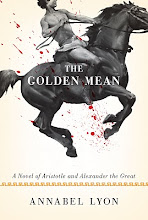
So was Aristotle really a misogynist? Since he was also a slave-owner, the question might seem trivial. But it was still a question I had to reckon with as I created the character of his wife, Pythias. We know for certain little more than her name, and that she bore him a daughter, also named Pythias. She died before her husband, who (after her death, in my imagining, though in reality who knows) took a companion named Herpyllis, who outlived him (he made provision for her in his will; more about her in a future post).
A typical woman of Pythias' time and status would have lived an exceedingly circumscribed life. She would have received no formal education, and would probably have married in her early teens. She would not have had possessions; she would not have left the house very often; she would probably have been illiterate; she would have had a good chance of dying in childbirth.
Not the happiest bundle of probabilities. As a 21st century novelist--as a 21st century
woman--I wanted more for her. I thought about different ways of introducing a strong female character into the novel, but they were all cliches of one sort or another. Aristotle's wife really wrote his books! Aristotle was secretly engaged in a taboo love affair! Female academic, 2400 years later, uncovers some shocking secret about the great man!
None of these appealed to me. Partly because they've been done, sometimes wonderfully well (think of
A.S. Byatt's
Possession); partly because they felt dishonest. I wanted to look history in the eye and reckon with the woman as she probably was, not as I anachronistically wanted her to be. In
The Golden Mean, Pythias is neither bright nor stupid, beautiful nor ugly. She wants a child but doesn't really like sex. She's literate (I made this a pet project of her husband's), but doesn't make much use of this gift. She's quiet. She has kindness in her and a bit of unexpected steel, too. She likes nice clothes. She dies too soon, in fear, and leaves behind a frightened, lonely little daughter.
Aristotle's own writings clearly rate women's intelligence beneath men's, and approves of their status as second-class citizens. I don't like the fact that he owned slaves, either; I hate it. But I couldn't bring myself to blink these things away. Fiction requires its own kind of fidelity. "Tell the truth, but tell it slant," Emily Dickinson famously wrote. For me, the operative word here is
truth. Fiction is not the place for self-indulgent wish-fulfillment, even when you've got the moral high ground and the best of intentions. With Pythias, I had to choose between feeling good and feeling true. I chose true.